Responsible Business

The Noble Code: Our foundation of ethics and integrity

Noble adheres to high standards for ethics and integrity, health and safety, environmental stewardship and respect around the world.

At Noble, being a responsible business means always doing what is right. We believe doing the right thing is good for our stakeholders and our business and enhances our ability to be the first choice offshore driller. In practice, Noble adheres to high standards for ethics and integrity, health and safety, environmental stewardship and respect around the world. 

We have a deep commitment to ethics and compliance founded on a duty to our employees, customers, vendors, stakeholders, society and the environment in all aspects of our business. The Noble Code explains our duty and our commitments to our people, our community and our world, why they matter and how we do what is right. Our Code is a living, active reference with instructions that guide us as individuals and as a company, providing a model for ethical decision-making to help us choose the right path.

The Code covers a wide variety of issues related to sustainability, health and safety, environmental responsibility and our relationships. Working in tandem with the Noble Code, our management system provides detailed guidance, through policies and procedures, for following our mission, vision and values.

Noble’s Chief Compliance Officer, who has direct access to the chairperson of the Audit Committee and reports to the full Audit Committee quarterly on our Code and ethics and compliance program.

“Noble carries our understanding of ethical business everywhere we go. We communicate our standards and provide training for employees, rig workers and intermediaries, and require 
them to meet our standards. 

Our customers have the same expectations of Noble and we meet their high ethical standards.”

Emily Buchanan
Chief Compliance Officer

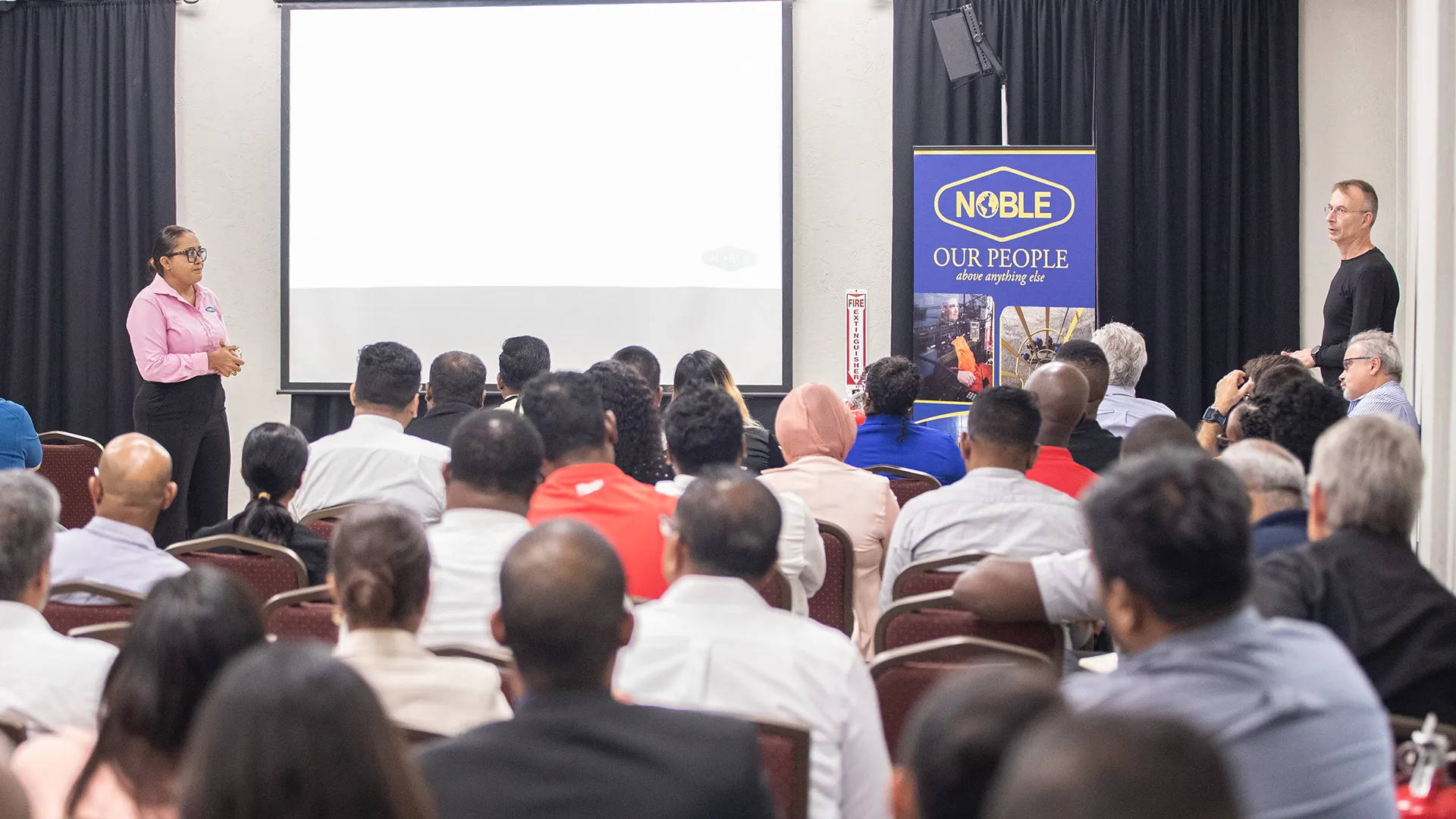
Expanding in-person training

The Noble Code applies to all employees, executives, officers and members of our Board of Directors, and is available online in ten languages. All third parties doing work for Noble must have their own code that encompasses our principles, or must adopt our Noble Code.

Employees take online training on the Code upon hiring and an online Code refresher at least once a year, while employees in onshore offices take in-person refreshers every other year. 

In 2024, our ethics and compliance team conducted in-person training at the majority of our offices and initiated in-person training on rigs. We are committed to 100% completion of online training and to providing in-person training at all offices and most rigs every two years.

Ethics and compliance training in 2024

93%

completion of online training

92%

completion of in-person training by target audience at shorebases and major offices globally

Conducted in-person training in 5 offices and on 3 rigs worldwide

Training in 2024 raised awareness of our process for reporting concerns and potential Code violations or illegal or unethical business conduct. Employees are obligated to report concerns and we provide multiple channels to fulfill this obligation. In addition to using our anonymous, confidential NobleLine resource, employees can contact the designated person ashore or a representative of human resources, ethics and compliance, legal, finance, internal audit or HSE. The Company pledges to receive reports anonymously, investigate reports and enforce the company’s non-retaliation policy for reports made in good faith.

We are committed to engaging employees on ethics and compliance through training, an app, a dedicated internal website and ongoing executive advocacy on our strong culture of ethics. We believe that following laws, complying with regulations and adhering to high global standards will help Noble be a sustainable enterprise.

Noble 2024 Sustainability Report

For a deeper dive, explore the full PDF report with more extensive insights and details.
PDF 14.4 MB
Download PDF

Data

Caring for People

Making safety second nature: Learning from Normal Work and Noble Peak

A strong safety culture should be built upon the successful everyday practices that are happening offshore.

For too long our industry has approached incident prevention from the perspective of “Safety-I” which focuses on analyzing failure, adverse events, and accidents after the fact. Human factors researchers suggest that safety critical industries should learn from everyday successful work in addition to incidents and failures. This is the definition of “Safety-II,” which focuses on studying normal and successful work, performance, and processes. Safety-II learns from everything happening in the system, from good to bad. This proactive approach encourages continuous learning and improvement, as compared to a reactive approach, which we believe cannot truly prevent future incidents.

Since 2022, Noble has been implementing Learning from Normal Work within the HSE department and on board several rigs in our fleet. Additionally, subject matter experts have taken the program externally to serve as an example to the industry, positioning us as leaders in preventative incident management.  

Safety-I
Learning based on failure, adverse events, and accidents after the fact.
Safety-II
Learning based on normal and successful work, performance, and processes.

The Learning from Normal Work concept emphasizes understanding and learning from everyday operations, not just from incidents.

The purpose of Learning from Normal Work is to address safety as not only a top-down process through formalized procedures but also as a bottom-up process where the frontline worker builds capacity and resilience into the work processes through the way they act, interact, and co-create the conditions of their work. Personnel are viewed as a solution, not a problem that requires control. 
We empower rig personnel to contribute to the entire system and have greater influence on how the company enhances onsite safety.

Noble’s pilot approach in Learning from Normal Work included three methods:

The onboard studies of positive practice  
The development of learning material based on positive examples from the onboard observations
Training of onboard leaders as facilitators in the Learning Teams format and in how to use the learning material

In 2024, Noble’s HSE department worked on defining the scope of Learning from Normal Work and how it integrates with other state-of-the-art safety concepts under the umbrella of Noble Peak, which is what defines Noble’s core safety policy. Noble Peak is an eclectic approach that integrates the best aspects from methods like Safety-II, Safety as Capacity, Safety Differently, Human and Organizational Performance (HOP), and Learning from Normal Work into our organization.

The three principles of Noble Peak are as follows:

Empower Our People

We recognize people as the solution 
and engage them as co-creators.

Reinforce What’s Working

We focus on what’s strong and
not what’s wrong.

Embrace Variability

We are inspired by new ideas 
and accept that there can be more than one correct way of doing things.

Learning from positive examples is foundational to our Learning from Normal Work program. During rig operations, positive work examples are observed by peers or leaders and documented for further exploration within learning teams. A Learning Team is an interactive tool intentionally designed to be “bottom up” for reflection and dialogue-based learning within a collective group. 

Noble is revisiting and adjusting tools that have been established and used for a long time to fit with the Learning from Normal Work framework. For example, transition to work meetings fit within the “Empower Our People” principle, which leverages team members’ capacity to plan, communicate, and act effectively. Stop work drills fit within the “Embrace Variability” principle, which encourages hearing and sharing ideas. 

We already recognize the positive effects of implementing Learning from Normal Work and Noble Mode on performance metrics and work culture.

“Safety-II focuses on learning from everyday successes to improve safety, rather than just analyzing failures. At Noble, this approach empowers workers and recognizes positive practices, making the system more resilient and safe.”

We already recognize the positive effects of implementing Learning from Normal Work and Noble Peak on performance metrics and work culture. Crews feel appreciated when their contributions are acknowledged and are more willing to speak up during operations when necessary. When a crew member feels psychologically safe, they’re more willing to speak up or use Stop Work Authority after observing something that might be wrong. As a result, our systems become more resilient. 

Noble 2024 Sustainability Report

For a deeper dive, explore the full PDF report with more extensive insights and details.
PDF 14.4 MB
Download PDF

Noble’s commitment to developing future subsea engineers

Responsible Business

Collaborating to unlock collective and corporate opportunities

Noble is a member of a unique offshore development alliance that is transforming the nature of collaboration with operators and competitors alike.

The Wells Alliance Guyana is a collaborative working relationship of the operator, Noble and one other drilling contractor, and three service providers as one unified team, working toward a shared vision: 
To be the undisputed leader in the deepwater well construction business to unlock future opportunities.

Established in August 2024, the Alliance is not a legally binding business partnership or joint venture arrangement. Instead, it thrives on trust, transparency and alignment with shared values and behaviors. Strong governance practices reinforce this commitment, enabling future projects and long-term value creation for stakeholders. While Alliance members remain committed to fair competition and full compliance with anti-trust laws, they collaborate closely on operations, leveraging each company’s strengths to drive efficiency. 

Through alliances, we sharpen our ability to listen, learn and improve all aspects of our business.

We believe that helping unlock future opportunities for the Wells Alliance Guyana, we will also unlock new possibilities for Noble.

Taking responsibility and accountability for outcomes is a hallmark of the collaboration. KPIs (key performance indicators) support the Alliance vision and include cost per day, cost per well and days per well, and members are incentivized to excel beyond stated performance goals. The long-term nature of the contract allows Alliance members to take a team- and goal-oriented approach to performance, with the objectives of removing waste, streamlining delivery, optimizing resources and continuously improving operations and HSE.

When the Alliance challenged drillers to cut drilling time for deepwater wells in half, Noble was able to study every step of the drilling process and think outside the box to develop solutions. We met the challenge and continue to identify repeatable processes that allow us to save time, reduce cost, enhance safety and potentially to cut emissions. Repeatability also allows the Alliance to plan and forecast more effectively. 

Wells Alliance Guyana Values:

Care for Others
Own the Outcome
Motivate One Another
Maintain Integrity
Inspire Innovation
Trust Each Other

The Alliance is also streamlining the supply chain, identifying opportunities to share resources and optimize equipment usage. With multiple rigs operating, drillers have reduced the amount of spare equipment on board, significantly reducing transport needs and costs.

Investment in automation, energy, energy-efficient equipment and technology that enhances operational and safety performance while lowering environmental impact. Highly automated rigs reduce risks by eliminating process variations and preventing safety incidents.

Membership in the Wells Alliance Guyana requires a strong, long-term commitment to collective success. Noble’s participation in the Alliance has strengthened our ability to work in a unified manner, refining our approach to collaboration.

Through alliances, we sharpen our ability to listen, learn and improve all aspects of our business.

We believe that helping unlock future opportunities for the Wells Alliance Guyana, we will also unlock new possibilities for Noble.

Noble 2024 Sustainability Report

For a deeper dive, explore the full PDF report with more extensive insights and details.
PDF 14.4 MB
Download PDF

The Noble Code: Our foundation of ethics and integrity

Responsible Business

Field trip to Noble drillship engages next-generation workforce

Students from the University of Texas experienced offshore drilling firsthand, gaining valuable insights into a high-tech, safety-focused industry.

A conversation at an industry conference led to a unique learning experience for petroleum engineering students from the University of Texas (UT) at Austin and for Noble.

In October 2024, students spent a day on the Noble Globetrotter II drillship, warm-stacked off of Port Fourchon, Louisiana. Seeing the equipment, drill floor and living areas firsthand opened their eyes to the high-tech, safety-focused world of offshore drilling and insights into daily life on the vessel and industry careers.

For Noble, hosting future engineering talent provided an opportunity to spark interest in offshore drilling careers and showcase the company’s commitment to innovation and safety. Following the visit, Noble extended onshore and offshore internship offers to several students inspired by what they saw and learned.  

19

students, including 12 women, with specific interest in the drilling industry participated in the field trip.

The idea for the field trip grew out of a conversation between a Noble Offshore Improvement Manager and a professor in the UT Austin Hildebrand Department of Petroleum and Geosystems Engineering at the 2024 IADC Advanced Rig Technology Conference. Both recognized the value of demonstrating that offshore drilling can be a fulfilling career choice.

The professor selected 19 students, including 12 women, from 100 applicants in his undergraduate drilling class, prioritizing those who expressed specific interest in the drilling industry.

The visit on Noble Globetrotter II started with Noble’s onboarding, including training on emergency procedures and PPE. The students observed the riser system, moonpool, BOP and other rig components and systems, and visited the drill floor to learn about the rig’s autotripping system. Because the rig was stacked, they had exclusive access to areas typically off-limits when the rig is operational.

“I hope the industry as a whole looks at something like this and sees how easily it can be done. We should also tap more into the potential of our crews by having them talk to prospective students who want to work in our industry. On the visit, they proved to be very effective ambassadors of our industry because of their authenticity.”

Robert van Kuilenburg
Offshore Improvement Manager

As part of the living quarters tour, students received mock cabin assignments, ate in the galley, and spoke with crew members about their jobs and careers. The experience gave students a deeper appreciation of Noble’s efforts to supporting its workforce.

Noble continues to look for innovative ways to help us attract our next-generation workforce.

Noble 2024 Sustainability Report

For a deeper dive, explore the full PDF report with more extensive insights and details.
PDF 14.4 MB
Download PDF

Collaborating to unlock collective and corporate opportunities

Caring for People

Empowering Guyanese talent and creating economic opportunities

Noble has demonstrated a strong dedication to fostering professional development and creating economic opportunities for Guyanese nationals.

Noble has demonstrated a strong commitment to fostering professional development and creating economic opportunities for Guyanese nationals. Noble’s dedication is exemplified by scholarship program support and the remarkable careers of Denzel Southwell.

Through our launch of the Noble Marine Cadet Program in 2024, full scholarships were awarded to six Guyanese nationals. In 2025, this number will increase to twenty, providing more individuals with the opportunity to pursue careers in the marine sector. The program is designed to equip recipients with the necessary qualifications to excel in the offshore industry. Upon completing their training, these scholars are guaranteed employment, ensuring immediate job opportunities that contribute to the local economy. 

+70

direct local service providers engaged, along with staffing all offshore assets with Guyanese doctors

400

Guyanese personnel were directly supporting Noble’s oil and gas and well delivery efforts

Since operations began in 2018, Noble has prioritized local workforce development in Guyana. Our initiatives include staffing all offshore assets with Guyanese doctors and working with over 70 direct local service providers. As of June 2024, approximately 400 Guyanese personnel were directly supporting Noble’s oil and gas and well delivery efforts. These initiatives not only boost the local economy but also ensure that Guyanese professionals are at the forefront of the country’s growing oil and gas industry. 

The story of Denzel Southwell further highlights Noble Corporation’s strong focus on nurturing local talent and fostering career growth.

Southwell’s journey with Noble began in January 2021 when he joined the Noble Tom Madden drillship as a Roustabout. His talents were quickly recognized, leading to a promotion to Rig Administrator.

He then joined the Operations Management Development Program (OMDP), which required a deep understanding of drilling operations. Denzel worked his way through various roles, including Floorhand, Shaker Hand, and Drilling Fluid Operator. In January 2024, he became Guyana’s first Auxillary Assistant Driller with the El Dorado Offshore (EDO) team. Denzel has since transitioned from an agency position to a direct hire role with Noble in Guyana.

Denzel’s rise through the ranks is truly inspiring because it shows the potential for growth and success within the industry to many aspiring Guyanese professionals. 

By prioritizing the development of Guyanese professionals, Noble is not only contributing to the country’s economic growth but also building a skilled and capable workforce that will drive the industry forward for years to come.

Noble 2024
Sustainability Report

For a deeper dive, explore the full PDF report with more extensive insights and details.
PDF 14.4 MB
Download PDF

Strengthening governance in critical incident risk management
across the fleet

Caring for People

Barrier Management 2.0: Strengthening governance in critical incident risk management across the fleet

In 2024, Noble strengthened its barrier management by implementing digital tools and solutions that provide a real-time view of cumulative asset risks and enable thorough integration of barrier management’s technical, operational, and organizational components. 

As a leader in the offshore drilling industry, Noble takes risk management seriously. Daily rig operations involve high complexity and significant risks. While our crews are highly skilled in executing safe operations, catastrophic events – such as casualties, explosions, structural damage, collisions or major environmental incidents – can have severe consequences including loss of life and ecological impact.

Across the industry, barrier management establishes and provides the framework to maintain multiple independent barriers to reduce risk and safeguard life, assets, and the environment from Major Accident Hazards (MAHs). 

This framework is deeply embedded in Noble’s culture and aligns with our vision to be the leading offshore driller, recognized as the First Choice for employees, customers and investors. Both regulators and customers are increasingly emphasizing the need for a robust barrier management approach. 

In 2024, Noble continued to strengthen its barrier management by implementing high-level management digital tools and solutions that provide a real-time view of cumulative asset risks.

Following Noble and Maersk Drilling’s combination, we developed a Barrier Management Strategy to require multiple independent barriers are in place to control risks and prevent cascading failures. 

This strategy standardizes technical, procedural, and organizational barriers across all units, aligning with the expectations of tier-one customers and global regulatory requirements.

Building upon our industry-leading risk management practices, in 2024, Noble continued to strengthen its barrier management by implementing high-level management digital tools consisting of dashboards displaying leading indicators over time.

By visualizing all barrier-related tools, systems and data outputs, we have created robust barrier integrity dashboards for each rig. This empowers our teams to make informed decisions, enhancing safety and efficiency.

While external pressures drive the need for a robust barrier management strategy, we see it as more than a requirement – it is a fundamental commitment to our mission, our vision, and most importantly, the safety of our crews.

Noble 2024 Sustainability Report

For a deeper dive, explore the full PDF report with more extensive insights and details.
PDF 14.4 MB
Download PDF

Responsible
Business

Caring for People

Noble’s commitment to developing future subsea engineers

For over a decade, Noble has been dedicated to cultivating the next generation of subsea engineers through its subsea development program.

This initiative equips engineers with the skills needed to maintain subsea well control equipment on Noble’s rigs. The program recruits trainees from within the company – including lower-level rig crew members recommended by rig managers, recent engineering graduates, and former military personnel. Over 18 to 24 months, trainees rotate between classroom instruction at Noble’s Houston training facility, visits to OEM partners, and hands-on experience during 28-day rotations on Noble’s rigs.

The curriculum covers a wide range of topics, including hydraulic systems, mechanical training, and BOP (Blowout Preventer) operations. Additionally, the program emphasizes communication, teamwork, safe work practices, and the policies and procedures essential for safe rig operations.

Carl Lyle, who oversees the Well Control Equipment Training and Development Program at Noble, explains:

“We identified a need for a structured training program for our subsea engineers, given the technical nature of the role. It’s challenging to provide comprehensive training solely on the rig, so we developed a program that includes extensive off-rig training. This approach has been instrumental in meeting our ongoing demand for qualified subsea engineers.“

Practical exercises are a key component of the program, offering trainees real-world scenario experience. During rig rotations, trainees are paired with experienced team leaders who mentor them in applying classroom knowledge. Buford Sullivent, a Senior Subsea Engineer at Noble, highlights the value of on-rig time, noting that certain equipment, like motion compensation systems, are easier to understand in operation.

Effective communication is another critical aspect of the training. Trainees learn to interact with different departments on a rig to resolve issues. Sullivent adds, “Understanding how to communicate with various departments is essential. When working on a problem, trainees need to know whom to contact and how to request information. Utilizing these communication channels is vital for rig operations.”

“In a classroom, you can learn about tensioners and crown-mounted compensators (CMCs) through pictures, diagrams, and videos, but seeing them in action is crucial. Experiencing the equipment in use, such as weighing up the drill string and adjusting pressures, is invaluable for trainees. It’s challenging to grasp all the training data until you witness everything working together on a ship out at sea,” Sullivent explains.

The program also offers a clear path to career advancement within the company. Upon graduation, trainees are assigned to a rig as assistant subsea engineers, receiving further mentorship from subsea supervisors. Typically, within two years, graduates are promoted to subsea engineer positions, with several advancing to senior roles.

Step 1:
Trainee & graduation
Step 2:
Assistant subsea engineers
Step 3:
Subsea engineer positions
Step 4:
Advancing to senior roles

Many individuals working on our well control equipment or in the office have progressed through this program, advancing to subsea supervisors, superintendents, and even management and director positions. This progression showcases the quality of our training program,” Lyle concludes.

Noble 2024 Sustainability Report

For a deeper dive, explore the full PDF report with more extensive insights and details.
PDF 14.4 MB
Download PDF

Empowering Guyanese Talent and Creating Economic Opportunities

Sustainable Energy Future

Preparing for the emerging offshore CCS market

Noble is at the forefront of advancing offshore carbon capture and storage (CCS), a critical component of a lower-carbon future.

In the coming decades, offshore CCS is expected to store 25-50% of the millions of tons of CO₂ captured from industrial sites. Noble is preparing to be the first-choice provider of safe, cost-effective and scalable operations in offshore carbon storage reservoirs.

We are a partner in multiple research and development projects advancing the technology and operational capabilities needed to safely inject industrial-scale volumes of CO₂ into offshore reservoirs. We are applying our learnings – along with our technology acumen and innovation capacity – to work toward industry standards for equipment and rigs to serve the emerging market for offshore CCS.  

First-choice provider of safe…
…cost-effective CCS solutions

Planning for industry standard certification 

As a participant in the Project Greensand consortium, Noble played a key role in the world’s first cross-border CO₂ value chain for offshore storage. Our Noble Resolve jackup rig was deployed for the first injection of CO₂, which was captured shoreside, transported across national borders, and injected offshore Denmark at the Nini platform. We have an exclusive first right to all drilling work involved in Project Greensand until the end of 2027.

Building on expertise gained through Project Greensand, Noble launched the industry’s first CO₂ rig technology qualification program in collaboration with DNV and BP. This initiative focuses on developing a CCS-enabled rig design for drilling and workover operations in CO₂-rich environments. 
The initial phase of the program, completed in 2023, included a full technology assessment, risk analysis, and equipment testing to address the unique challenges posed by CO₂ in well control events.  

Through this work, Noble established key design enhancements, including:

Improved ventilation systems for CO₂ dispersion
Personal breathing apparatuses for personnel in potential exposure zones
An innovative bypass system to safely manage CO₂ 
influxes without requiring major modifications to existing 
well control equipment

These findings form the foundation of the CO₂-certified rig project, which continues to align operators, OEMs, and regulators around the technical solutions necessary to enable safe and efficient CO₂ drilling operations. 

In June 2024, together with DNV and Endeavor Technologies, Noble conducted a CO₂ well drilling simulation to model the challenges of supercritical CO₂ downhole in various well control scenarios. The simulation was designed to help drillers, operators and others begin to plan for industry standard certification for CO₂-enabled drilling rigs. 

Electrical CO₂ Enabler is a crucial system to enable an offshore drilling unit to safely handle and operate in high purity CO₂ charged reservoirs.

To continue building on our offshore CCS knowledge, Noble joined the Project Green Light R&D initiative developing the first well control software designed specifically for CO₂ drilling operations. Led by eDrilling, the project aims to enhance drilling safety by simulating dynamic well control scenarios and mitigating risks where CO₂ plumes may interfere with well construction. Noble contributes operational expertise to this effort, reinforcing its focus on enabling safe and scalable offshore carbon storage.

Additionally, in 2025 Noble will participate in drilling a research well at the Petroleum Engineering Research, Training and Testing Lab at the Louisiana State University (LSU). This well will be used to study how CO₂ behaves throughout the wellbore as it transitions between different phases, while also providing a controlled environment to test materials and equipment under high-CO₂ conditions. 

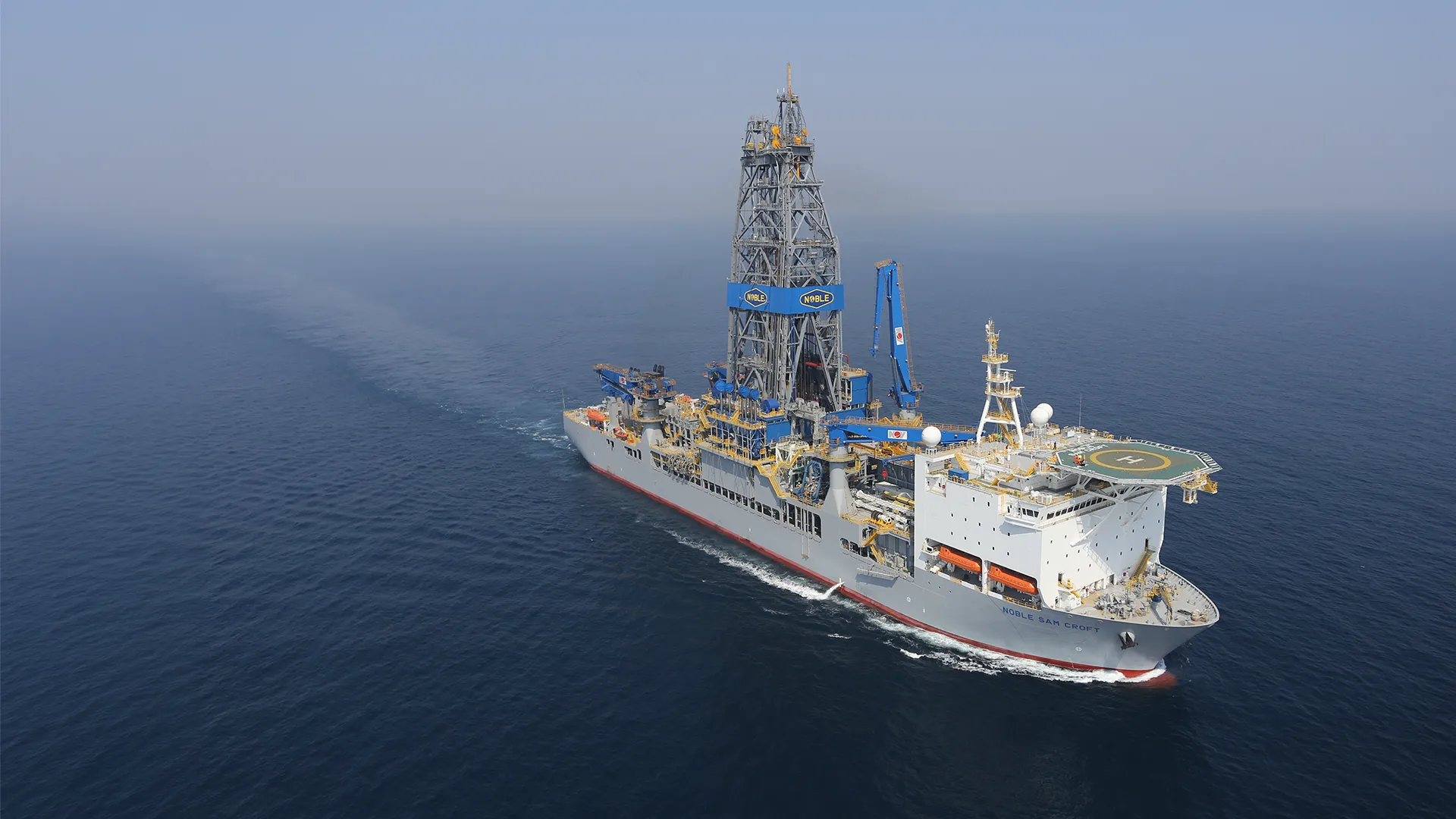
As a participant in the Project Greensand consortium, the Noble Resolve jackup rig was deployed for the first injection of CO₂. The CO₂ was captured shoreside, transported across national borders, and injected offshore 
at Denmark’s Nini platform.

“Our dedication to innovation and safety in CO₂ drilling operations is unwavering. By developing and implementing advanced technologies, we are not only setting new industry standards but also paving the way for a sustainable future in offshore carbon storage.”

Looking ahead, Noble has identified several near-term North Sea CCS projects that align with its jackup fleet, requiring extensive CO₂ injection well drilling and legacy well workovers before 2030. Offshore CCS projects are also expanding in the U.S. Gulf Coast, South-east, and Mid-Atlantic regions, offering additional opportunities to apply Noble’s expertise. 

By leveraging existing assets and experience, we believe Noble is well positioned to support the growth of the offshore CCS market, aligning with its decarbonization strategy and dedication to enabling a more Sustainable Energy Future. 

Noble 2024 Sustainability Report

For a deeper dive, explore the full PDF report with more extensive insights and details.
PDF 14.4 MB
Download PDF

Caring for People

Sustainable Energy Future

EnergyWise: Empowering rig crews to drive energy efficiency

EnergyWise is Noble’s all-hands-on-deck approach to reducing energy consumption through sustainable operations.

Designed to help achieve our GHG emission intensity reduction target by 2030, the program empowers employees and third parties on our rigs to implement practical, energy-saving behaviors – contributing to an expected 6% reduction in energy consumption.

EnergyWise is contributing to an expected
6%
reduction in energy consumption

Through education, engagement, and recognition, EnergyWise fosters a culture of continuous improvement in energy management.

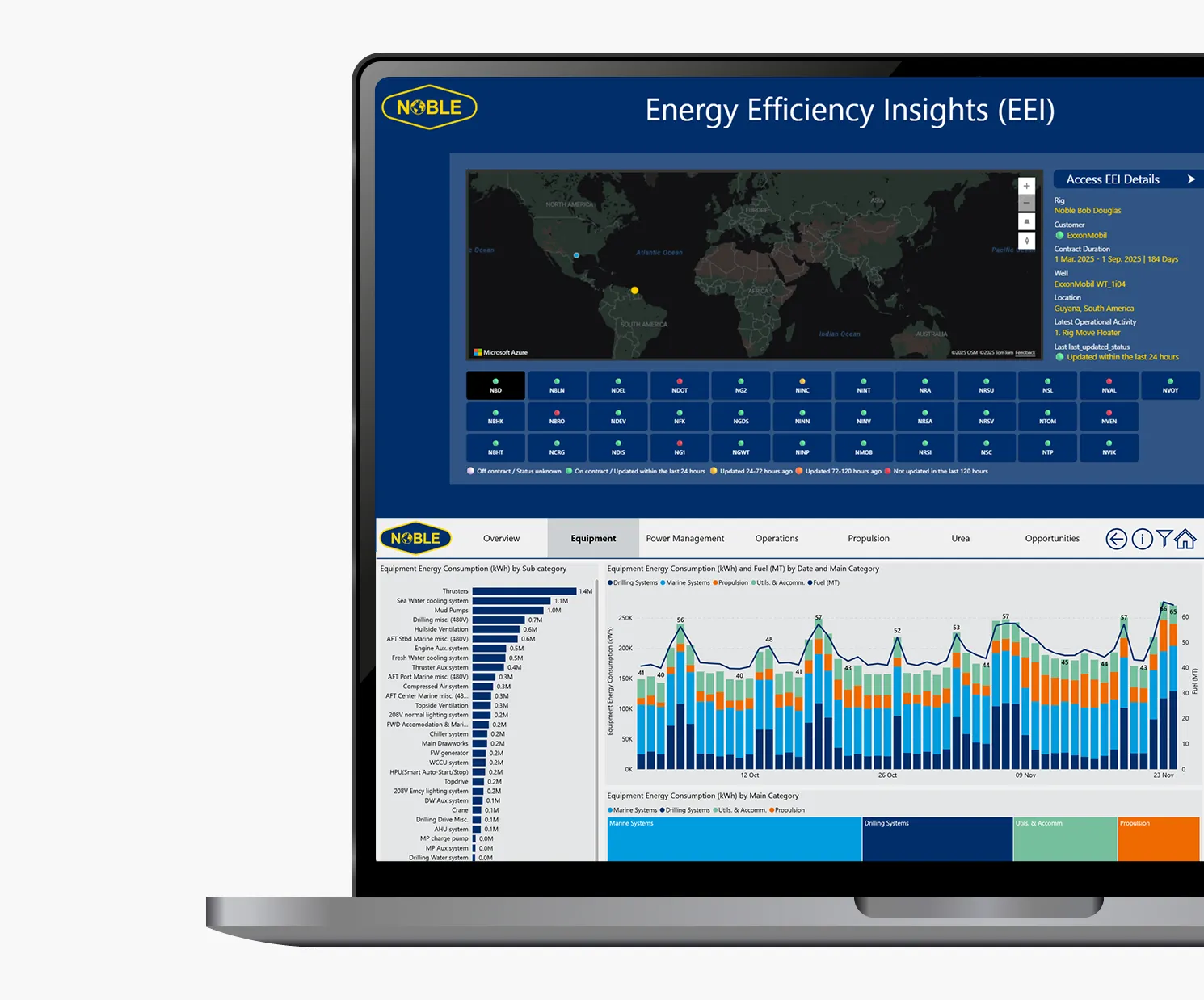
Rig crews can proactively identify energy-saving opportunities using our 3C Observation Tool, which can be accessed anywhere on the rig via a mobile device. Rig Sustainability Committees then review and prioritize these EnergyWise alerts while also monitoring fuel consumption trends to drive efficiency gains. 

Education
Engagement
Recognition

In 2024, over 400 EnergyWise alerts were submitted across our fleet. The alerts included positive behaviors such as turning off pumps when not in use, as well as technical upgrade opportunities. Crew members also proposed ideas for managing and reducing waste, such as minimizing single-use plastics, and for optimizing maintenance to save time and reduce energy use. The diversity of insights highlights our crews’ dedication to sustainable operations – both as individuals and as part of the Noble team. 

+400

EnergyWise alerts were submitted across our fleet in 2024.

In 2025, we intend to begin implementing energy-efficient behaviors suggested by our rig crews as part of rig-specific energy management plans. These plans, coupled with the energy policy approved by our board in 2024, will support Noble’s ISO 50001 compliance roadmap and enhance our ability to meet customer expectations for sustainability. 

Through EnergyWise, we continue to empower our crews, enhance operational efficiency, and reinforce our emphasis on sustainable offshore operations. By tapping into the knowledge and innovation of those on the rig floor, we are making meaningful strides toward improved energy efficiency and more sustainable offshore operations. 

Noble 2024 Sustainability Report

For a deeper dive, explore the full PDF report with more extensive insights and details.

PDF 14.4 MB
Download PDF

Preparing for the emerging offshore CCS market

Sustainable Energy Future

Noble’s deep dive into using green methanol in offshore operations

Integrating green methanol into offshore operations can reduce the environmental footprint and contribute to broader energy transition and decarbonization programs.

To reach decarbonization targets and comply with regulations aimed at reducing greenhouse gas (GHG) emissions, the offshore drilling industry must consider powering operations with low-carbon fuels instead of marine fuel oil, LNG and other conventional fuels. Using alternative low-carbon fuels, however, requires innovation and investment to retrofit existing assets and build new assets over time.

To understand the adaptations needed to operate an offshore drilling rig using an emerging low-carbon fuel, Noble relied on our 360-degree decarbonization model. In collaboration with a customer and a third-party design consultancy, Noble conducted a feasibility study of the safety, operational and feasibility aspects of upgrading a harsh environment jackup rig offshore Norway, using green methanol as a key component. 

Navigating the regulatory landscape

Our team started by meeting with stakeholders such as Class, Flag State authorities and local regulatory bodies to understand the regulatory landscape for the application of alternative fuels and if additional requirements would apply for offshore drilling units. In particular, we also needed to know if the green methanol rig concept would meet International Maritime Organization (IMO) expectations to reduce 20-30% of GHG emissions by 2030 to drive their 2050 net-zero scenario. All stakeholders agreed it would be feasible and that existing guidelines and regulations from Class and IMO would apply.

Assessing technical feasibility

Noble conducted an in-depth study of: 

Fuel-flexible engine technology
Advanced methanol storage tanks
Double-walled piping systems 

We also assessed the impact of adding green fuel engines, tanks and related equipment on the rig’s variable deck load capacity and operations. 

The feasibility study concluded that it is possible to upgrade a rig to enable green methanol use, 
at a considerable investment, and that more progress is needed to attain a reliable supply of green methanol. Based on the study findings, Noble developed a conceptual design of the world’s first green methanol drilling rig.

Integrating green methanol into offshore operations can reduce a company’s environmental footprint and contribute to broader energy transition and decarbonization programs. Noble continues to apply our 360-degree decarbonization model to implement data and technical upgrades, partner with customers and operationalize solutions to achieve a Sustainable Energy Future.

Noble 2024 Sustainability Report

For a deeper dive, explore the full PDF report with more extensive insights and details.
PDF 14.4 MB
Download PDF

EnergyWise: Empowering rig crews to drive energy efficiency